Key takeaways
- Nature-related risks are context-specific: company dependencies and impacts can reveal portfolio vulnerabilities.
- Our Nature Tool brings data into focus: comparing portfolio and benchmark exposures highlights areas for closer analysis.
- The insights support better questions: providing a starting point for research, stewardship and client conversations.
When an investment portfolio contains hundreds of companies operating across different sectors and geographies, where do you start with nature? Investors know nature matters, but the challenge is knowing what to ask and where to look.
Nature is becoming an increasingly prominent business issue. In the Taskforce for Nature-related Financial Disclosures' (TNFD) 2025 Status Report, 63% of organisations surveyed said nature-related issues were as significant as, or more significant than, climate-related issues to their future business prospects. One year later, the TNFD reported that investors were increasingly viewing nature loss as a source of financial and systemic risk, highlighting growing awareness of nature-related issues across capital markets.
TNFD reported 63% of organisations surveyed said nature-related issues were as significant as, or more significant than, climate-related issues to their future business prospects.
Investment teams increasingly need to understand:
- Where do nature-related risks and dependencies exist within their portfolios?
- Which companies rely most heavily on natural systems?
- Where are the greatest pressures on nature occurring within a portfolio?
- What information can meaningfully support investment analysis and stewardship?
Understanding the relationship between companies and nature can help investment teams begin to answer these questions and identify where further investigation may be most useful.
This article explores that challenge and introduces our nature lens with a tool we recently developed to support our analysis with data-driven insights.
Why nature matters to investors
Almost every company depends on nature to some extent:
- Food producers rely on healthy soils, water and pollination to grow their crops.
- Pharmaceutical companies draw on biological resources in the development and production of medicines [1].
- Artificial intelligence may seem far removed from the natural world, yet the data centres enabling it can use substantial quantities of water to cool heat-generating servers [2].
- Even the semiconductors inside those data centre servers rely on ultrapure water during fabrication, for example to remove residues and contaminants during chip production [3].
The economy is embedded within nature because economic activity ultimately depends on functioning natural systems. Clean water, productive soils, a stable climate and healthy ecosystems provide resources and services that businesses cannot always replace through technology or additional capital. Companies depend on nature through the natural resources and ecosystem services [4] they use, such as timber, clean water and pollination. They also impact nature through pressures such as resource over-extraction, land-use change and pollution. As natural systems decline through these pressures, companies may face higher costs, interruptions to production, supply-chain disruption and regulatory change, with potential implications for financial performance.
The economy is embedded within nature because economic activity ultimately depends on functioning natural systems.
For example:
- A business operating a water-intensive facility in a water-scarce area could face higher operating or infrastructure costs, greater scrutiny over local water use, or constraints on future production. The same level of water consumption may therefore have very different implications depending on where it occurs and how important that site is to the company; or
- A chemical spill near an important river could disrupt production, require costly clean-up and affect communities or businesses that rely on the waterway. The consequences depend on the substance released, the condition of the local environment and the importance of the affected site to the company.
For fund managers, understanding these relationships can serve two related and interconnected purposes.
| 1. It can direct research, to help identify the risks that nature loss presents to companies and portfolios. | 2. It can also drive stewardship and policy engagement towards the activities and locations placing the greatest pressure on natural systems to manage those risks. |
Frameworks such as the TNFD are helping businesses and financial institutions examine these relationships and integrate nature-related risks and opportunities into decision-making.
COP17’s [5] provisional agenda includes the first global review of collective progress towards implementing the Kunming-Montreal Global Biodiversity Framework, alongside discussions on resource mobilisation and the Framework’s monitoring arrangements.
For investment managers, this reinforces the value of decision-useful nature information, while recognising that data and methods are still developing.
Making complexity useful
Investment teams are used to making decisions with incomplete information and uncertain outcomes. Nature does not change that fundamental task, but it introduces a less familiar set of dependencies, pressures and data points that investors need to interpret.
Natural systems are deeply interconnected, and changes in one part of a system can have consequences elsewhere, sometimes emerging gradually and sometimes appearing suddenly once a critical threshold has been crossed.
Nature also resists the simplicity of a single measure. Unlike greenhouse gas emissions, pressures such as water use, pollution and land-use change cannot readily be expressed in one broadly comparable unit. Context matters. For example, the significance of a company’s water consumption depends not only on how much it uses, but where that use occurs, the condition of the local water system and how important the location is to its operations.
The challenge is therefore to translate complexity into decision-useful insights without creating a false impression of certainty. While the systemic risks arising from nature loss are unlikely to be fully addressed through portfolio-level analysis alone, investors can examine whether a portfolio is more or less exposed than its benchmark to particular pressures and vulnerabilities. This can help identify where relative exposure is concentrated, which holdings are driving it and where further research or stewardship may be most useful.
Our nature lens
With so many different data points to consider, investors need a way to bring them together and identify where further analysis may be useful.
This is the purpose of Royal London Asset Management’s Nature Tool. It brings together portfolio and benchmark holdings with company, sector and location-based information to help identify potential exposure to selected drivers of nature loss. This is not a linear assessment and should not be viewed in isolation. Instead, it provides an additional lens that can be used alongside investment analysis, stewardship and company research to help prioritise areas for further investigation.
Rather than reducing nature-related issues to a single score, the tool examines factors such as water use, land-use change and pollution, helping users understand what is driving a portfolio’s overall exposure. This can help highlight companies for further investigation and identify potential priorities for our nature-related engagement. Applying the same measures to the portfolio and its benchmark provides a reference point for assessing whether exposures are higher or lower than those of the benchmark and for identifying the holdings and factors driving that difference.
Water: a practical example
Approximately US$339 billion of potential financial impacts linked to water-related risks, including water scarcity, flooding and water quality issues.
The potential financial significance of water-related risks is substantial. Companies reporting through the Carbon Disclosure Project (CDP) in 2024 identified approximately US$339 billion of potential financial impacts linked to water-related risks, including water scarcity, flooding and water quality issues. These are company estimates of potential impacts rather than realised losses, but they illustrate why investors are paying closer attention to where and how companies use water.
Illustrative example of what our nature insights show us
Comparing water intensity across a portfolio and the benchmark companies helps indicate whether a portfolio has relatively greater exposure to water-intensive businesses. The weight of each holding then shows how much it contributes to the portfolio's overall exposure.
Figure 1. Comparison of portfolio and benchmark water intensity.
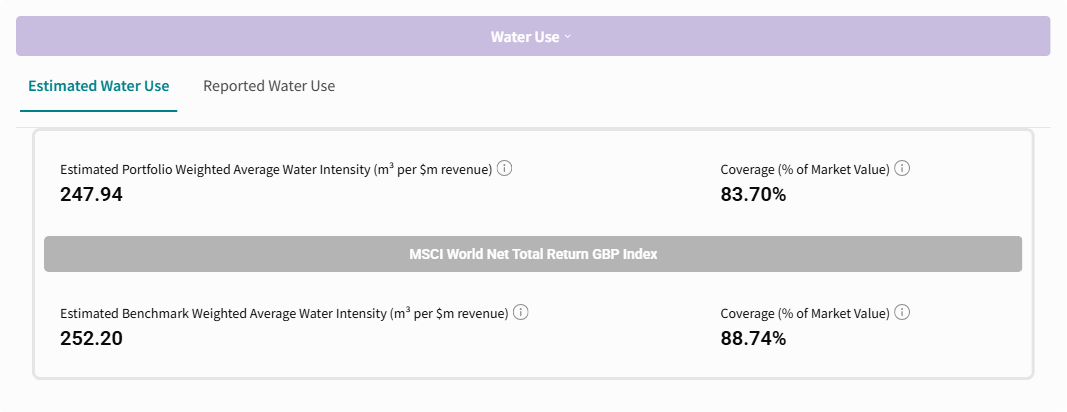 Source: Royal London Asset Management & MSCI as of July 2026. Illustrative comparison of portfolio and benchmark weighted average water intensity (m³ per $m revenue). Lower values indicate less water use per unit of revenue generated. Coverage shows the proportion of portfolio and benchmark market value for which water-use data is available. For illustrative purposes only.
However, water intensity alone tells only part of the story. Combining water-use data with information on operations in water-scarce locations helps identify where high water demand overlaps with pressure on local water resources.
This reflects a broader trend in investor expectations. The TNFD's 2026 Status Report found strong investor demand for location-specific information, recognising that the significance of nature-related risks often depends on where they occur rather than simply how large they are.
Figure 2. Where high corporate water use overlaps with water scarcity
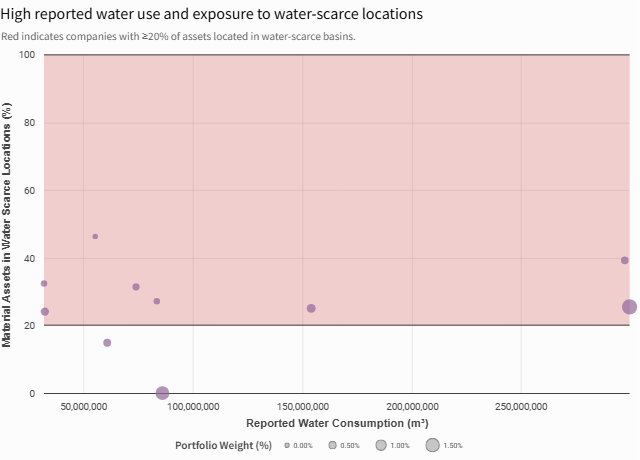
Source: Royal London Asset Management, MSCI & Nature Alpha as of July 2026. Illustrative portfolio holdings whose reported water consumption is in the highest quartile of the investment universe. Dot size represents each holding’s portfolio weight. The shaded red area identifies companies with 20% or more of their material assets located in water-scarce basins. For illustrative purposes only.
What insights can this provide? An analyst can then do further research or engagement with the company on the importance of the exposed facilities, how water demand could change as the company grows and whether its water strategy adequately responds to local conditions and future growth.
What is the outcome? The result is not a prediction of financial loss or an automatic investment conclusion. It is a structured starting point for identifying where further research may be needed, prioritising engagement and supporting discussions with companies, investment teams and clients.
Helping investors ask better questions
Nature-related data remains incomplete and often estimated. Location data may not capture entire supply chains, while proximity to a sensitive ecosystem does not in itself demonstrate impact. Some risks also operate across whole ecosystems and economies, making them difficult to assign neatly to individual companies.
Our nature lens insights do not remove these limitations, they can however help:
- Bring selected information into a consistent structure
- Identify where closer examination may be worthwhile
- Focus research and stewardship resources
- Test existing assumptions; and
- Communicate more clearly with clients about a set of risks that has historically been difficult to articulate.
As the evidence develops, so will our nature lens. Its value comes not from offering certainty in a complex system, but from helping investors understand where vulnerability and influence may lie – and ask better questions as a result.
References
[1] Many medicines are developed using substances found in plants, animals and microorganisms. Damage to nature could reduce access to resources that may support future drug discovery.
[2] Some data centres use water to prevent computing equipment from overheating. This can create risks in places where water is scarce or where local supplies and infrastructure are already under pressure.
[3] Ultrapure water is water cleaned to an extremely high standard. Chip manufacturers need large and reliable supplies because even tiny impurities can damage chips during production. This dependence can become risky where suitable water is scarce, costly or difficult to access.
[4] Ecosystem services are the benefits that people and businesses receive from nature, including clean water, pollination, productive soils and natural flood protection.
[5] COP17 is the seventeenth meeting of the countries that are parties to the Convention on Biological Diversity, the main global agreement for protecting biodiversity is taking place in Yerevan, Armenia, from 19 to 30 October 2026.
Read more of our nature views
Royal London Asset Management engages with companies as part of its responsible investment and stewardship strategy, aiming to drive long-term value for clients while promoting sustainable business practices.
Our voting, engagement and advocacy activities are designed to be pragmatic, informed by research, evolving market insights and local best practice, and aligned with the long-term interests of our clients. These activities aim to enhance the value and integrity of our investment decisions.
Voting and engagements may not always apply to any specific Royal London Asset Management fund or strategy, as each will have different investment objectives. Please check your prospectus for details on specific product objectives.
For professional investors only. This material is not suitable for a retail audience. Capital at risk. This is a financial promotion and is not investment advice. Past performance is not a guide to future performance. Reference to any security is for information purposes only and should not be considered a recommendation to buy or sell. The views expressed are those of the author at the date of publication unless otherwise indicated, which are subject to change.