
We were pleased to be named Leader in Net Zero Stewardship – Europe 2026 at the Responsible Investing Awards from Capital Finance International.


Key takeaways
- Different sectors, different conversations: we use a consistent climate framework but tailor engagement to sector-specific challenges, including an engagement-first approach for companies involved in controversial fossil fuel activities.
- Escalating where necessary: when concerns persisted, progress stalled or confidence in delivery weakened, we used our voting rights to hold boards accountable.
- Strengthening our toolkit:
- Research: we enhanced our Climate Transition Assessment (CTA) methodology to distinguish more clearly between ambition and evidence of delivery.
- Policy advocacy: we engaged policymakers, regulators and industry bodies to address barriers to real-world decarbonisation.
Recognition of our approach

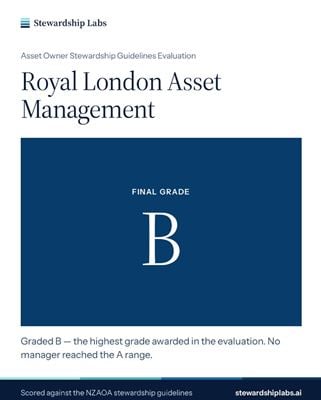
Recently received recognition as one of five asset managers receiving a Straight B against a systematic, academically independent assessment of how 250+ asset managers meet the Net Zero Asset Owner Alliance stewardship guidelines.
Past performance is not an indication of future results. Awards are not a recommendation.
Climate commitment
We monitor progress against our climate commitments:
50%
Reduce emissions of our investments [1] by 50% by 2030…
70%
…by engaging with issuers representing 70% of our financed emissions…
2050
…to achieve net zero [1] by 2050
[1] tCO2e/$m invested, relative to a 2020 baseline.
Net Zero Stewardship Programme
During the first half of 2026, our Net Zero Stewardship Programme (NZSP) combined company engagement, climate-related voting and research.
The transition is moving from target-setting to delivery. Our stewardship must therefore distinguish stated ambition from credible evidence of progress.
So far this year, this meant:
- greater focus on companies with fossil fuel exposure, with voting used where escalation was warranted;
- engagement with 58 companies, representing 38.4% of our financed emissions; and
- enhancements to our CTA methodology, alongside policy advocacy on the conditions needed for decarbonisation.
The figure below compares the number of companies assessed in the first half of 2026 and 2025, alongside the proportion of financed emissions represented by those companies. While more companies were assessed in 2026, many represented a relatively smaller share of financed emissions.
Figure 1: January to June 2026 engagement outreach
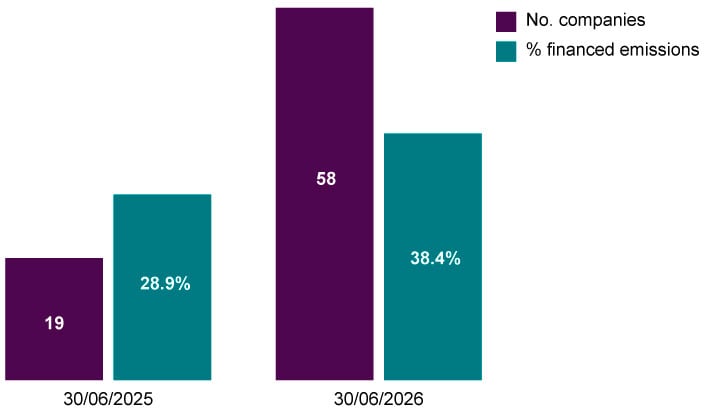
Source: Royal London Asset Management. January to June 2025 and January to June 2026 data is shown as at 30 June and is not directly comparable with full-year figures.
While some companies continue to strengthen climate plans and disclosures, progress remains uneven. Many companies now have long-term ambitions in place, but the challenge increasingly lies in translating these commitments into tangible outcomes. Delivery is also harder amid divergent US policy and evolving UK and European disclosure frameworks.
While some companies continue to strengthen climate plans and disclosures, progress remains uneven.
In our 2025 annual Stewardship and Responsible Investment Report [1], we provided an in-depth analysis of the diversified mining, utilities and oil and gas sectors. A supplementary document [2] to this report detailed more of our proprietary Net Zero Stewardship Programme Climate Transition-Assessment.
To complement this earlier reporting, this article focuses on company performance, sector-specific engagement, climate voting and our enhanced methodology. For investors, the central question is whether corporate commitments are translating into credible plans, capital allocation and measurable progress.
Earlier this year our approach was recognised when we were named ‘Leader in Net Zero Stewardship – Europe 2026’ at the Capital Finance International Responsible Investing Awards and recently received recognition as one of five asset managers receiving a Straight B against a systematic, academically independent assessment of how 250+ asset managers meet the Net Zero Asset Owner Alliance stewardship guidelines by Stewardship labs.
Past performance is not an indication of future results. Awards are not a recommendation.
Company performance: what is changing?
Our latest assessments indicate positive but mostly incremental progress.
Figure 2: Climate Transition Assessment performance status of 13 companies
| Improvers | No change | Deteriorators |
| 38.5% | 46.2% | 15.4% |
Source: Royal London Asset Management. Based on 13 companies assessed by 30 June 2026; status reflects changes across the CTA indicators.
The picture is one of movement, but not uniform momentum. Across the companies assessed during the period, progress was positive but largely incremental.
- Five companies improved, although most gains were concentrated in one or two areas of the framework and only one company moved forward across three indicators.
- Financial institutions, particularly banks, accounted for much of the positive movement, suggesting that some parts of the market are beginning to translate climate commitments into stronger governance, client engagement and capital allocation practices.
- At the same time, almost half of the companies out of the thirteen which were assessed in H1 showed no overall change, indicating that some transition plans may be plateauing rather than continuing to mature.
- Deterioration was limited to two companies, with both regressing against an equal number of indicators, reinforcing the importance of looking beyond headline commitments to assess whether progress is broad-based, sustained and supported by credible evidence of delivery.
Sector engagements: applying a sector-specific lens
Energy
In 2026 so far, our engagements aligned with the Royal London Fossil Fuel Position Statement [3]. For companies involved in controversial fossil fuel* activities, our starting point is engagement: assessing transition plans, setting expectations and advocating for the policy and market frameworks needed for change.
Where progress is insufficient or material risks remain unmanaged, we can and have escalated through voting, intensified engagement, capital reallocation or divestment, as appropriate. This builds on our 2025 phase-out of pure-play thermal coal companies.
Crucially, we also engaged UK policymakers and trade associations on structural barriers to an orderly transition. Company-level escalation examples appear in the voting section below.
*Controversial fossil fuels include thermal coal, oil sands and arctic oil.
Industrials
Industrial companies often depend on customer demand, infrastructure and wider system change as well as their own operational plans.
In Q1, we met Hitachi to discuss how its eco-design could reduce emissions from the use of its products and how progress depends partly on electricity-grid decarbonisation.
We welcomed Hitachi’s focus on eco-design and its decision not to rely on offsets for Scope 3 emissions. We encouraged clearer evidence of how these measures will deliver reductions.
Financials
CASE STUDY
Barclays
- Sector: Financials
- Location: UK
In Q2, we met Barclays’ Climate and Investor Relations teams. We welcomed expansion of its Client Transition Framework and progress towards facilitating US$1 trillion in sustainable and transition finance by 2030. This contributed to the improvement of 2 indicators in our 2026 CTA of Barclays.
We challenged Barclays on the coverage of financed-emissions targets and asked for clearer disclosure of how its Client Transition Framework influences financing decisions and climate-risk management. Barclays explained that the Framework provides a client-level assessment tool used in engagement discussions and that governance processes review significant score changes and any actions that may be required.
Outcome: During the year, Barclays strengthened and expanded its Client Transition Framework and provided additional evidence of how climate considerations are integrated into client engagement and decision-making. These developments led to upgrades in the Client Engagement indicator and the indicator which covers climate scenario stress-testing of our Climate Transition Assessment.
Figure 3: Barclays Assessment Overview
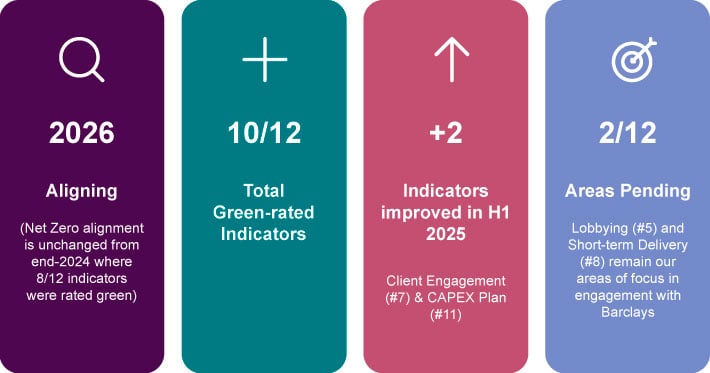
The numbers within this image refer to our 12 indicators which can be in the latest Net Zero Stewardship supplement.
A sector-specific approach for financial institutions, allows us to understand their transition progress, and evaluate whether financing decisions are supporting real-world decarbonisation and mitigating transition risks.
Climate votes during the first half of 2026
As the focus shifts from climate ambition to delivery, voting is an important escalation tool where engagement has not resolved concerns or confidence in implementation, governance or accountability weakens.
In 2026, roughly 85% of the companies we held equity in on our NZSP had Annual General Meetings (AGMs) to end June 2026. We discuss our approach to climate-related voting in more detail in our Proxy Season Review.
The examples below show how research, engagement and our CTAs informed decisions during the January to June 2026 proxy season, the heaviest semester for climate votes.
Almost 80% of climate-related votes against directors were at energy and utility companies, reflecting increased focus on fossil fuels and coal. We voted against management recommendation on directors at 20 energy and utility companies where transition plans, fossil fuel exposure or engagement outcomes fell short of expectations.
Figure 4: Climate voting figures for January to June 2026
| Voted against directors on climate grounds at: |
Supported shareholder resolutions on climate: |
Supported “say on climate” votes at: |
| 25 companies in our NZSP | 4 companies in our NZSP | 1 company in our NZSP |
| 44 companies in total | 26 companies in total | 7 companies in total |
CASE STUDY
HSBC - Chair of the Group Risk Committee and Chair of the Sustainability Working Group.
- Sector: Financials
- Location: Global
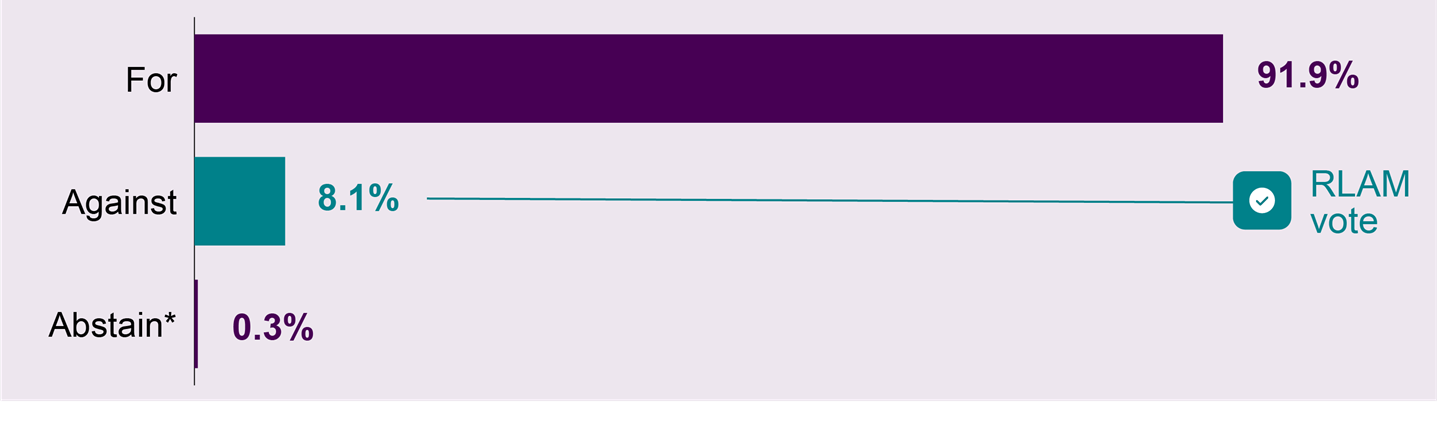
We have engaged with HSBC, a global bank, on climate change and the just transition since 2021. After sustained engagement, we voted against the chairs of the Group Risk Committee and Sustainability Working Group.
Outcome: Revisions to HSBC’s financed-emissions targets and oil and gas financing policies reduced our confidence in delivery. We therefore voted against the re-election of the Chair of the Group Risk Committee and the Chair of the Sustainability Working Group. We will continue engaging with HSBC on how it can strengthen its transition strategy.
Figure 5: HSBC Assessment Overview
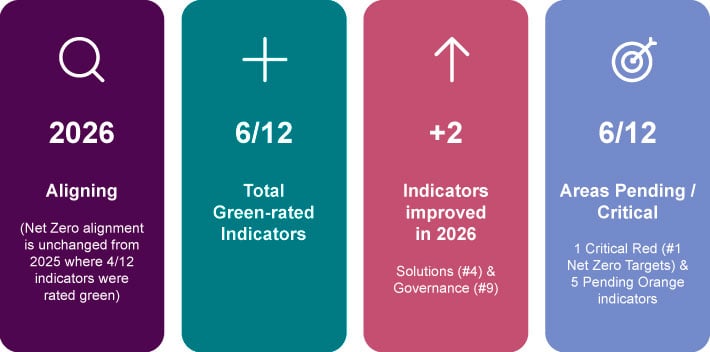
The numbers within this image refer to our financial 12 indicators for banks and financials which can be in the latest Net Zero Stewardship supplement.
Chair of Group Risk Committee
Chair of Sustainability Working Group
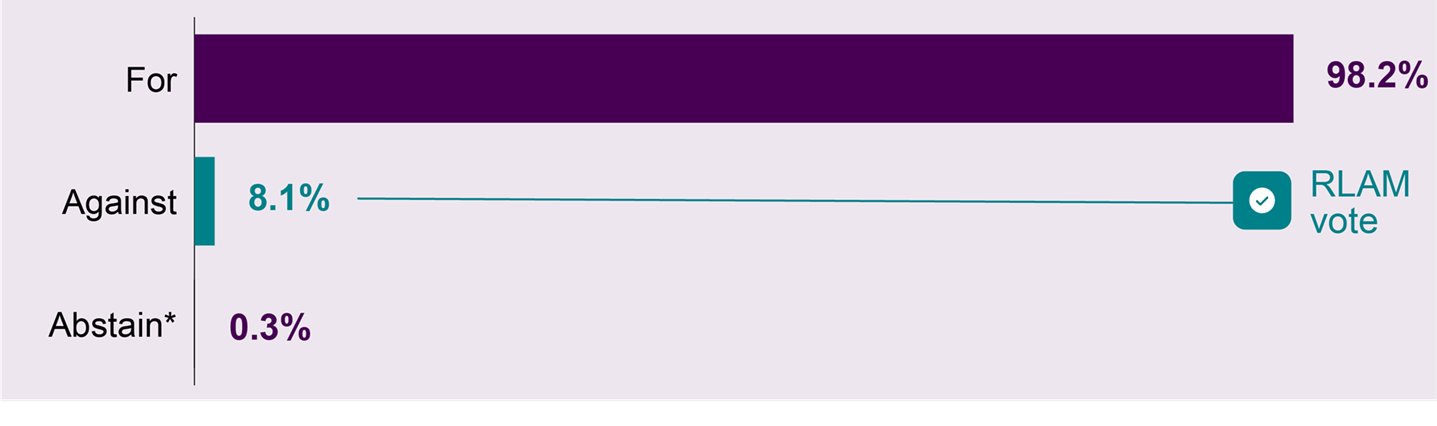
* ‘Abstain’ under English law is not counted in the calculation of the votes ‘For’ or ‘Against’, hence the numbers may not always add up to 100%. The figures have been rounded to one decimal place.
CASE STUDY
BP – voted against the election of Chair
- Sector: Energy
- Location: UK
BP, a British multinational oil and gas company, is a significant contributor to our financed emissions. We have engaged for several years on climate strategy, capital allocation and transition planning.
Outcome: Following BP’s 2025 strategic reset, we sought evidence that higher oil and gas investment remained consistent with its climate commitments and long-term value creation. Despite extensive engagement, including direct dialogue with BP's Senior Independent Director, we remained concerned about transparency, accountability and investors' ability to assess progress against climate commitments.
We therefore voted against the election of the Chair, opposed proposals to revoke historic climate disclosure commitments and supported a shareholder proposal requesting enhanced climate-related disclosure.
Chair of Sustainability Working Group 2
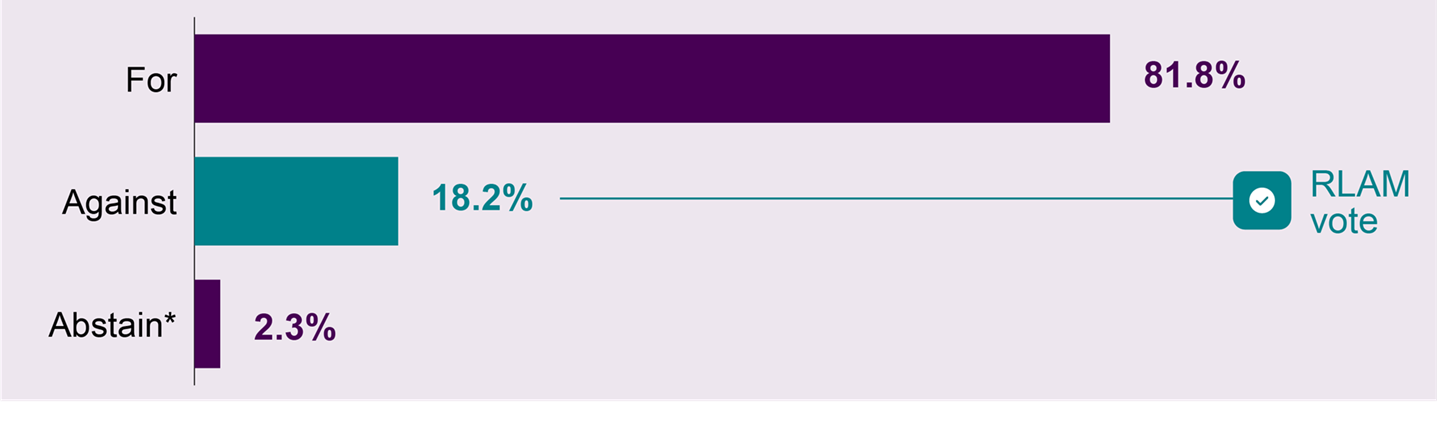
*’Abstain’ under English law is not counted in the calculation of the votes ‘For’ or ‘Against’, hence the numbers may not always add up to 100%. The figures have been rounded to one decimal place.
CASE STUDY
Glencore – voted against the re-election of the Chair of the Health, Safety, Environment & Communities (HSEC) Committee
- Sector: Diversified mining
- Location: Global
Royal London Asset Management has engaged with Glencore for several years. Insufficient disclosure of coal-related capital expenditure limits our ability to assess whether Glencore’s investment decisions support its stated thermal-coal wind-down strategy.
Outcome: Reflecting these concerns, we voted against the re-election of the Chair of the Health, Safety, Environment & Communities Committee. Our decision reflects the view that long-term climate commitments must be supported by transparent disclosure and credible evidence of delivery.
Chair of Sustainability Working Group 3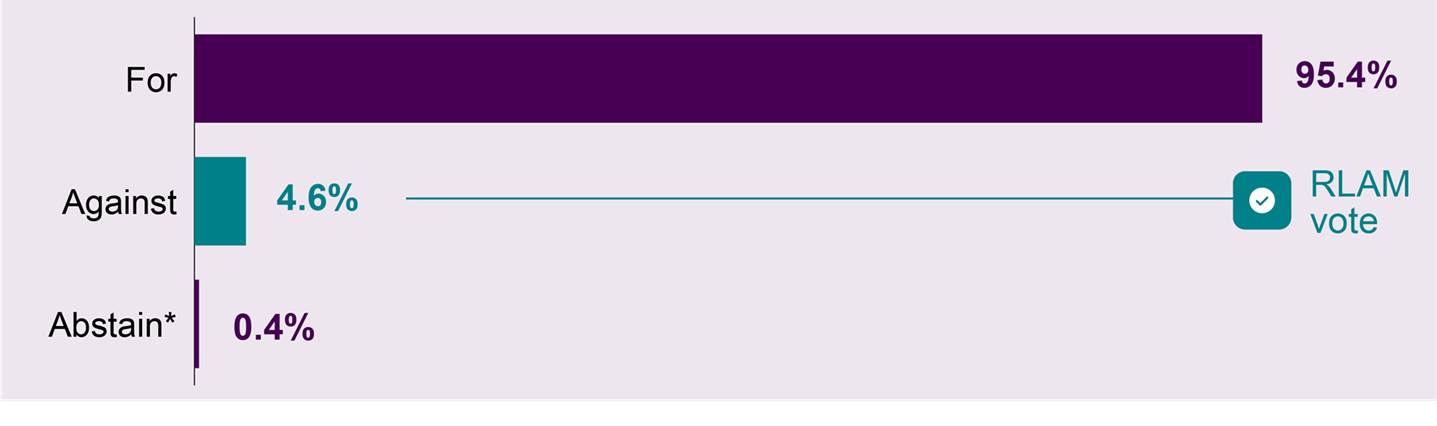
*’Abstain’ under English law is not counted in the calculation of the votes ‘For’ or ‘Against’, hence the numbers may not always add up to 100%. The figures have been rounded to one decimal place.
Policy engagement: unlocking real-world decarbonisation
Company engagement alone cannot deliver the transition. Many of the barriers identified through our Net Zero Stewardship Programme depend on the wider policy environment. Policy engagement therefore remains an important part of our stewardship approach.
Many of the barriers identified through our Net Zero Stewardship Programme depend on the wider policy environment.
So far this year, we engaged policymakers, regulators and industry bodies on electricity-market reform, carbon pricing, climate disclosure and transition finance. This advocacy addresses conditions individual businesses cannot change alone.
Read more about our approach in: No policy, no transition: Why investors must engage.
Enhancing our research methodology
As the transition to a low-carbon economy accelerates, distinguishing between ambition and action is becoming increasingly important. Companies are setting climate targets at pace, but targets alone do not tell us whether a business is successfully preparing for the risks and opportunities of the transition.
We enhanced our CTA methodology in H1 2026 to place greater weight on evidence of delivery and distinguish companies making meaningful progress from those at an earlier stage.
We also introduced a fifth alignment category, ‘Committed to aligning’, for companies with stated ambition but insufficient evidence of real-world progress.
| Leaders: Aligned and climate leaders | Aligned: Aligned to a net zero pathway | Aligning: Aligning towards a net zero pathway | NEW Committed to aligning: Ambition but no real-world progress | Not aligned: Not aligned |
The additional category separates early-stage commitments from demonstrated delivery. We also strengthened our assessment of sustained progress and real-world outcomes, rather than relying on headline commitments or short-term movements. Together, the changes help identify leaders and prioritise engagement.
Read more about the NZSP and our 12 Climate Transition Assessment indicators in our 2025 Net Zero Stewardship supplement.
Looking ahead
In H2 2026, we will expand our CTA coverage and use findings to prioritise engagement and escalation. We will continue testing the revised methodology against company evidence and engagement outcomes, including whether progress is sustained across reporting periods. Our focus will remain on credible delivery, not simply stronger statements of ambition, and on communicating decision-useful insights to investors.
Follow our latest responsible investment views for further updates.
[1] Stewardship and Responsible Investment Report
[2] Net Zero Stewardship Programme Climate Transition-Assessment
[3] Royal London Fossil Fuel Investments Position
[4] 2025 Net Zero Stewardship supplement
Royal London Asset Management engages with companies as part of its responsible investment and stewardship strategy, aiming to drive long-term value for clients while promoting sustainable business practices.
Our voting, engagement and advocacy activities are designed to be pragmatic, informed by research, evolving market insights and local best practice, and aligned with the long-term interests of our clients. These activities aim to enhance the value and integrity of our investment decisions.
Please note that voting and engagement practices may not apply uniformly across all Royal London Asset Management funds or strategies, as each has distinct investment objectives. Please refer to the investment documents for specific details.
For professional investors only. This material is not suitable for a retail audience. The value of investments and any income from them may go down as well as up and is not guaranteed. Investors may not get back the amount invested.
The views expressed are those of the author at the date of publication and are subject to change without notice. Not all strategies always consider climate in the same way, as each will have different investment objectives. Portfolio holdings are subject to change without notice. Forward looking statements are subject to certain risks and uncertainties, Actual outcomes may be materially different from those expressed or implied.

